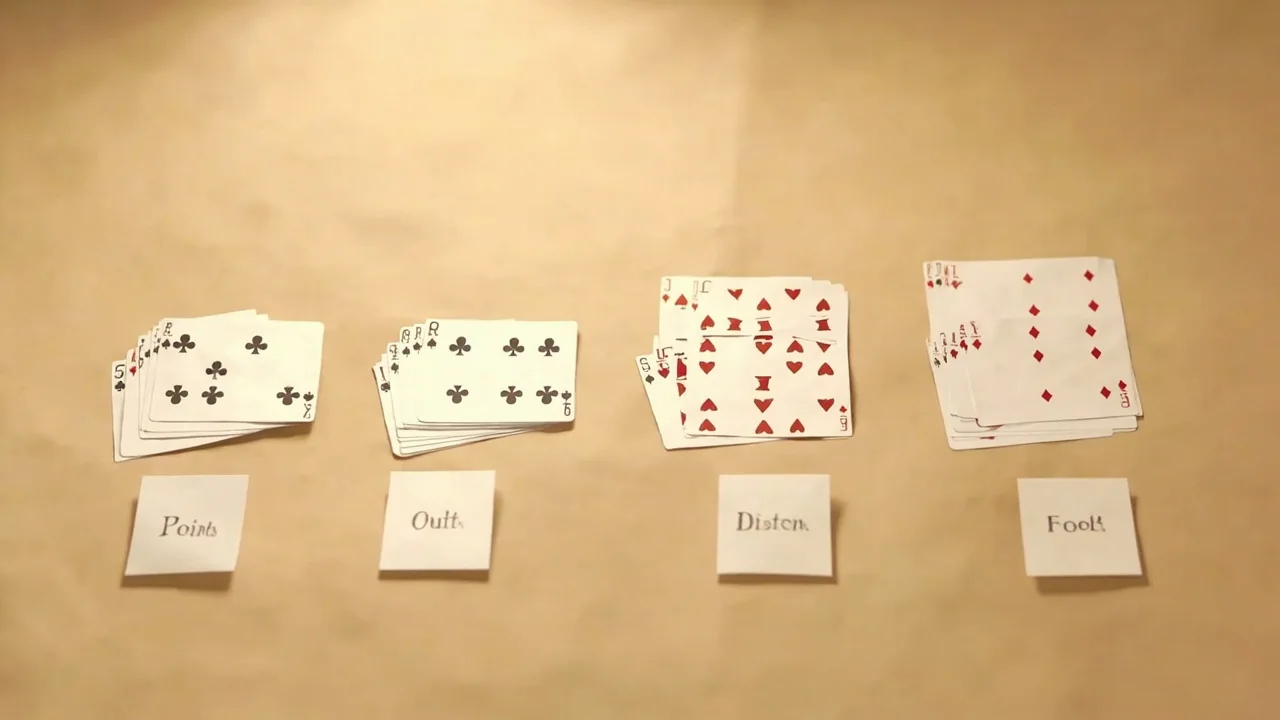
A 10cric rummy hand moves in five beats: deal, sort, draw, discard, declare. Each beat has one decision worth thinking about and three habits worth doing without thinking. This chapter walks through a single hand at an ordinary pace so a new reader can read along with a real game.
Before you open the lobby
Three habits prevent most mistakes on a first session. First, decide your session timer before opening the lobby and set a deposit ceiling above the entry stake; the responsible play chapter explains how. Second, read the lobby card of the table you intend to join — joker rule, drop values and max players are different on different tables. Third, accept that you will misread discards in your first few hands; the cost of a misread is a 25-point mid-drop, which is cheaper than declaring with high deadwood.
Beat 1 · The deal
Each player receives 13 cards face down; one card is placed face up on the discard pile and one card is designated as the wild joker for the round. The wild joker substitutes the rank of its printed value across all suits. Look at the wild joker immediately — a 7 wild joker is much easier to work with than a king wild joker because 7 sits inside a long sequence range.
Sorting takes 20-30 seconds and is the single best use of time at the start of every hand. Group the cards into suits and place the wild joker in its own row.
Beat 2 · The first draw
Your turn begins with a draw. The open pile's top card is visible and saves time; the closed pile's card is unknown but may complete a hidden sequence. Take the open card when it fits a sequence or set without breaking an existing one. Take the closed card when the open card is a high-point unmatched card that your opponent would otherwise pick up.
Three situations argue for taking the closed pile: when the open card is a high-point card no one needs, when the open card would complete an opponent's likely sequence, and when you have no idea what to do and need time to think.
Beat 3 · The discard
After the draw, place one card face up on the discard pile. The card you discard is the second decision of every turn. Discarding high-point unmatched cards (face cards, aces and jokers) is the standard defence against large losses on a missed declaration. Discarding a card that completes an opponent's likely sequence is the most expensive mistake a new player makes.
Track which cards your opponents have taken from the open pile across the round. A card that looks safe to you may be exactly the card one opponent is waiting for.
Beat 4 · The drop option
You may drop at the start of a deal (10 points to opponents), mid-deal (25 points to opponents) or by full-show (the value of your unmatched cards). Dropping is a normal decision, not a failure. The fixed cost of dropping mid-deal is almost always lower than declaring with high deadwood.
A useful rule: drop mid-deal when you cannot form a pure sequence by your fourth turn. By the fourth turn you have drawn four cards; if you do not yet see a clear pure sequence, the cost of staying in the hand is higher than the fixed drop penalty.
Beat 5 · The declaration
A declaration ends the round. On your turn, after drawing and before discarding, place the 14th card face-down on the discard pile and arrange your groupings: pure sequence, second sequence or set, and any remaining cards. The unmatched cards are your deadwood; their total is your score at show-out.
Re-check your groupings before declaring. The most common reason a declaration scores zero is a missing pure sequence — the joker does not substitute for a pure sequence under any rule published by 10cric.
After the declaration · the show
Once you declare, every player reveals their hand. The declarer's deadwood is zero; everyone else pays the declarer the point value of their unmatched cards, capped at 80 per player. Cards are scored: face cards, aces and jokers at 10 points; number cards at face value.
A worked scoring example
| Player | Pure | Impure | Sets | Drop | Deadwood |
|---|---|---|---|---|---|
| A · declared | 5♥ 6♥ 7♥ | — | 9♠ 9♦ | — | 0 |
| B | — | — | — | mid | 25 |
| C | 3♠ 4♠ 5♠ | JK 6♣ 7♣ | Q♠ Q♥ | — | 33 |
| D | — | — | — | early | 10 |
| Net · table | +0 | +0 | +0 | +35 | −33 − 10 − 25 |
Player A declares with one pure sequence (5♥–6♥–7♥) and a set (9♠–9♦). Player C declares with a pure sequence (3♠–4♠–5♠), an impure sequence using the joker (JK–6♣–7♣) and a set (Q♠–Q♥). A and C both have valid declarations; the higher valid declaration wins. If both declare in the same hand, A wins because the pure sequence outranks C's joker-substituted sequence.
Rules you can hold in your head
- Pure sequence firstSort your hand by suit and identify a pure sequence within the first 30 seconds.
- Track open-pile picksThe open pile is the only public information in a round.
- Drop early when stuckDrop mid-deal at 25 points when no pure sequence is visible by turn four.
- Discard high-point unmatched cardsFaces, aces and jokers are the most expensive cards to keep.
- Verify the lobby cardJoker rule, drop values and entry stake vary between tables.
What to read next
The strategy chapter extends the decision-making in this chapter to multi-hand pool tables and explains how to read discards at the table. The 10cric review chapter explains what the platform actually does on representative devices. The verification chapter explains what to prepare before your first withdrawal.
Mental shortcuts for new readers
Three mental shortcuts help a new reader keep pace with the table. First, after every draw, ask one question only: "does this card fit an existing sequence or set?" If yes, keep it; if no, treat it as discard material. Second, after every discard, count the points of your hand: face cards, aces and jokers at 10; number cards at face value. Third, before each declaration, re-read your groupings once more; the pure sequence must be there.
The shortcuts are not strategies. They are habits that buy time to think about the strategy questions that actually matter.
What to do after a re-deal
If the operator cancels a hand and re-deals, the table clock resets. Drop penalties do not carry over; players are not charged for the cancelled hand. A re-deal is the operator's decision, not a strategy decision, and the right response is to wait for the new deal.
How a single hand compares to a session
A single hand is a unit of risk. A session is a unit of plan. The two are linked but not identical. A working session plan sets a deposit ceiling, a session timer and a stop condition. A working hand plan is the five beats in this chapter. Each hand lives inside a session; the session plan is the frame, the hand plan is the content.
Frequently asked
How long does one hand of points rummy take?
One hand at a six-player table usually takes five to ten minutes; the timer on the lobby card is the operator's published estimate.
What is the difference between a pure and an impure sequence?
A pure sequence uses only cards of the same suit in consecutive order without a joker; an impure sequence completes a consecutive run using a joker as a substitute.
Can a joker substitute a card in a set?
A joker may substitute one card in a set of the same rank across suits, but a pure sequence cannot use a joker.